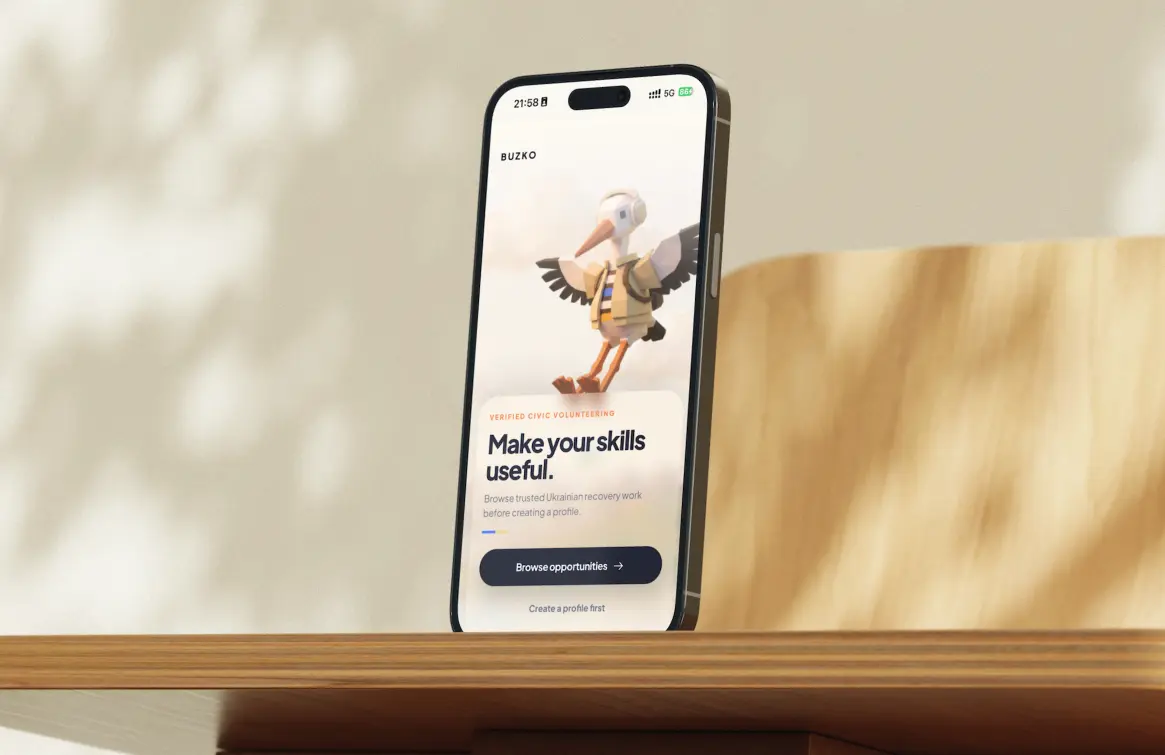
BUZKO
I developed BUZKO from an open research question into an evaluated tech for good app concept. The project shows how evidence changed the proposition, challenged early ideas, shaped five product rules, and drove two prototype iterations for helping Ukrainian diaspora professionals find verified, skills-based ways to contribute to Ukraine.
Civic Challenge
BUZKO is a concept for a “skills-based volunteering” app that helps Ukrainian diaspora professionals find verified ways to contribute to Ukraine’s recovery from abroad. The core problem wasn’t motivation—it was trust and clarity: people struggled to find credible opportunities, understand whether their skills fit, and commit without oversharing personal data.
Project Framework
Research
See note
The research approach followed informed consent, voluntary participation, data minimisation, and de-identification. In a project shaped by war, migration, and civic identity, this was part of the design quality rather than administrative overhead.
I used each method to answer a different product uncertainty. Desk research framed the civic and trust context; the survey tested the scale and pattern of the problem; co-design workshops challenged early interaction ideas; thematic analysis turned recurring evidence into product rules; and usability evaluation exposed where the first prototype failed. I triangulated findings before turning them into requirements.
Survey
See note
The evidence in this project should be read as a justified prototype direction rather than a population-level claim. The survey supports descriptive analysis, but its sample size is too small for strong statistical generalisation; the statistical report also notes that no inferential test reached conventional significance at p \< .05, and that several survey branches have smaller bases than the full sample.
| Signal | Evidence | What it meant |
|---|---|---|
| Connection remained high | 73% followed Ukrainian news actively; 63% felt a personal responsibility to contribute. | Awareness and identity were already present. More persuasion was not the main design problem. |
| Action remained low | 17% volunteered regularly, while 43% wanted to volunteer but had not found the right opportunity or time. | The product needed to reduce friction between intention and useful action. |
| Discovery was fragmented | 7 of 13 willing-but-blocked respondents ranked discovery first; only 7 of 30 knew Ukrainian Volunteer Service. | A credible, legible opportunity layer could create value without competing with Diia or existing NGOs. |
Participatory Design Workshop
See note
Several participants specified the need to enable in app donations. This also aligns with the survey results where we see that financial donation is still seen as a prevalent means of support for most diaspora members with 65.5% of sample ranking it as their first choice, whilst only 27.6% have selected “Skilled Volunteering” . Although this feature cannot be in the scope of the BUZKO app development, it cannot be ignored moving forward.
Participants kept returning to a more basic question than features: why trust this system with their time, data, and professional labour? It showed me that “less friction” isn’t always better—some friction can signal proof, boundaries, and accountability. Registration, time estimates, forms, chat, deadlines, and feedback weren’t just UI; they were signs of respect. BUZKO couldn’t simply match people to tasks—it had to earn trust step by step: let people look first, prove legitimacy, clarify the work, support negotiation, then ask for commitment.
The proposed journey: browse verified tasks → check trust signals → express interest → agree scope/terms → collaborate in a mission hub → confirm impact.
Assumption Audit
The research reframed BUZKO from a motivation problem into a conversion problem.
Diaspora professionals wanted to contribute, but action was blocked by unclear discovery, weak trust signals, uncertain skill-fit, vague scope, and limited proof that their work would create visible impact.
How might we turn diaspora willingness into trusted, skill-matched contribution by making legitimacy, fit, scope, and impact clear before commitment?
Product Strategy
See note
I deliberately paired JTBD with mental models because BUZKO was not primarily a demographic segmentation problem. A persona would have helped describe who the user is, but the research suggested that the more important question was what kind of progress a willing-but-blocked contributor was trying to make, and what conditions had to exist before they felt safe to act. JTBD defined that progress: moving from civic intention into a credible, bounded, skill-based contribution. Mental models then explained the assumptions users brought into that progress: that opportunities should be browsable before sign-up, legitimacy should be inspectable, interest should not equal commitment, and impact should be visible after completion. Used together, these frameworks allowed me to translate research into product sequencing rather than a static user profile. The strategy therefore became less about designing for “a type of user” and more about designing the conditions under which contribution becomes understandable, trustworthy, and safe to begin.
BUZKO’s UX/product strategy employs the Jobs to Be Done framework, mental-model analysis, and MVP scoping via a PRD framework. These frameworks effectively convert research into product logic. The strategy prioritises the sequencing of value, risk, and commitment: users first browse, assess trust cues, express interest, negotiate scope, confirm a lightweight agreement, and then commence work.
JTBD & Mental Models
Service Blueprint
Prototyping
First Iteration
Testing First Iteration
I tested the V1 prototype with six participants and combined behavioural, perceptual, quantitative, and qualitative evidence. Rather than letting one metric dictate the redesign, I used the methods together to identify recurring breakdowns and prioritise changes.
Second Iteration
Where this project sits
BUZKO evolved from a broad idea about diaspora participation into a coherent, evaluated product direction: a service model, five evidence-backed product rules, a coded end-to-end volunteer journey, and a V2 prototype shaped by observed usability problems. I did not launch a live civic platform or implement Diia integration. Instead, the project demonstrates how I moved from uncertainty to evidence, from evidence to product decisions, and from testing to iteration while keeping trust and unpaid labour at the centre.
Mentions
https://www.artsthread.com/portfolios/buzko-skills-based-volunteering-for-ukraine
https://degreeshow.mmu.ac.uk/2026/profiles/andi-patrylo/
Research limitations
-
The survey was small and skewed toward recent post-2022 arrivals, so inferential findings were exploratory rather than population-level claims.
-
The participatory workshops involved nine people in one UK city and included multilingual code-switching and a noisy café setting.
-
The usability sample was appropriate for formative diagnosis but too small for broad performance claims.
-
Proposed Diia verification, formal agreements, dispute resolution, and global expansion remain product hypotheses requiring legal, operational, and technical validation.
Selected evidence base
-
BUZKO Survey Analysis, March 2026.
-
BUZKO Synthesised Thematic Analysis, March 2026.
-
Braun, V. and Clarke, V. (2006),
Using thematic analysis in psychology
.
- Smith, A. and Thompson, M.,
The MIT D-Lab Participation Toolkit
.
-
Venkatesh, V., Thong, J.Y.L., Chan, F.K.Y. and Hu, P.J.H. (2016), Managing Citizens’ Uncertainty in E-Government Services.
-
Kozachenko, I. (2018), Re-Imagining the Homeland? Languages and National Belonging in Ukrainian Diasporas since the Euromaidan.
-
Villamil, A.N.,
The Ethical Researcher’s Checklist
.